Great advice found in the lobby of my gym.
Hang On.
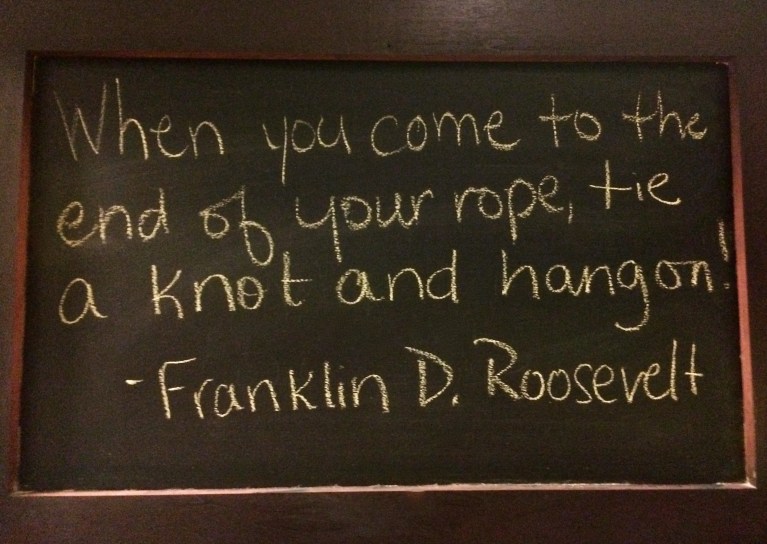

Great advice found in the lobby of my gym.

One of my best friends sent me the passage below a couple days ago. It really spoke to me. The author talks about optimism and the will to continue in spite of life’s many challenges. I find it relevant not only to those of us planning to take the bar again, but also for our colleagues who’ve passed but are still looking for employment.
Q
. . . About my personal philosophy. It is anchored in optimism. It must be, for optimism brings with it hope, a future with a purpose, and therefore, a will to fight for a better world. Without this optimism, there is no reason to carry on. If we think of the struggle as a climb up a mountain, then we must visualize a mountain with no top. We see a top, but when we finally reach it, the overcast rises and we find ourselves merely on a bluff. The mountain continues on up. Now we see the “real” top ahead of us, and strive for it, only to find we’ve reached another bluff, the top still above us. And so it goes on, interminably.
Knowing that the mountain has no top, that it is a perpetual quest from plateau to plateau, the questions arises, “Why the struggle, the conflict, the heartbreak, the danger, the sacrifice. Why the constant climb?” Our answer is the same as that which a real mountain climber gives when he is asked why he does what he does. “Because it’s there.” Because life is there ahead of you and either one tests oneself in its challenges or huddles in the valleys in a dreamless day-to-day existence whose only purpose is the preservation of an illusory security and safety. The latter is what the vast majority of people choose to do, fearing the adventure into the unknown. Paradoxically, they give up the dream of what may lie ahead on the heights of tomorrow for a perpetual nightmare—an endless succession of days fearing the loss of tenuous security.
Unlike the chore of the mythic Sisyphis, this challenge is not an endless pushing up of a boulder to the top of the hill, only to have it roll back again, the chore to be repeated eternally. It is pushing the boulder up an endless mountain, but, unlike Sisyphis, we are always going further upward. And also unlike Sisyphis, each stage of the trail upward is different, newly dramatic, an adventure each time.
At times we do fall back and become discouraged, but it is not that we are making no progress. Simply, this is the very nature of life—that it is a climb—and that the resolution of each issue in turn creates other issues, born of plights which are unimaginable today. The pursuit of happiness is never-ending; happiness lies in the pursuit.
-Saul Alinsky, Rules for Radicals

One of the more unsettling feelings that I’ve dealt with since finding out that I failed the bar exam is an overall sense that I was left behind. It started almost immediately when it seemed that everyone around me had passed but somehow, I hadn’t. While others were celebrating clearing this huge hurdle and moving on to greater opportunity, I was still stuck in limbo.
Thankfully, two things helped me to work through these feelings. The first came in a conversation with my parents. When I described this feeling to them, they gave me this advice: It’s not about anyone else. It’s not about your friends. It’s not about your classmates. It’s not even about us. It’s about you and your career. My parents helped me to realize that by focusing on feeling left behind, I wasn’t concentrating on what was really important, which was getting up, dusting myself off, and figuring out what needed to be done next. It was ok to be disappointed, but beating myself up by wallowing in the notion that I’d choked when others hadn’t was counterproductive. What was more important was learning from the situation, using it to better myself, and plotting a new trajectory.
The second thing that helped me was reaching out to others who also didn’t pass. For the first couple of days, I didn’t know of a single person besides myself who’d failed, but I knew they were out there. I desperately wanted to reach out to them, not for the sake of perpetuating the adage that “misery loves company,” but for comradery, and comfort in the knowledge that I wasn’t alone. When we finally started to find one another, it helped me to realize that it wasn’t the end of the world and that our time would soon come as well. Many of them were already on their feet and taking steps to prepare for the next exam. Through them, I found inspiration to help me move forward.
The feeling of being left behind is still very much present. It comes up whenever my colleagues post about getting interviews and starting new jobs. But by recognizing that the feeling is ultimately misguided, and that I’m not alone, I’m able to keep those feelings at bay. This not only allows me to join my colleagues in their happiness, but to also stay focused on what’s most important: finishing strong in February.
Q
A great TED Talk that a friend sent me over the weekend.
“Think back for a moment to elementary school. You’re sitting there in class, and your teacher is handing back quiz papers, and one of them looks like this [displays a spelling test graded with a C-]. This is not mine, by the way. (Laughter) So there you are in grade school,and you know exactly what to think about the kid who got this paper. It’s the dumb kid, the troublemaker, the one who never does his homework. So by the time you are nine years old, you’ve already learned, first of all, that people who get stuff wrong are lazy, irresponsible dimwits — and second of all, that the way to succeed in life is to never make any mistakes . . . according to this, getting something wrong means there’s something wrong with us.“
Don’t isolate yourself.
Out of all the advice I’ve received over the past week, this has by far been the most helpful. Heeding this advice is not only helping me through the almost grief-like beginning stages of acceptance, but it’s also helping me to foster a greater connection to everyone around me.
When I first found out that I’d failed the bar, my gut reaction was to hide away and not tell anyone. I felt that if I could hide my failure, even for just a little while, I could hang onto whatever shred of dignity I had left. Alone and terrified, I found myself quickly slipping into despair.
Despite feelings of shame and disappointment, however, I eventually found myself needing to reach out for support. The only thing I could do at first was text the simple phrase “I didn’t pass” to those closest to me, but that was enough. I can’t tell you how much of a relief it was to do so. Though I only told a handful of people that first day, those individuals kept me from going to a really dark place. For that I am forever grateful.
Even now, after over a week, I’m still fighting the urge hide away. The thought of avoiding people, conversations, and situations where the topic of bar exam might come up enters my mind quite often. But by fighting the urge to isolate, I’m not only learning more about myself and how I handle difficult situations, but also about empathy and the kindness of others.
I am so thankful for the outpouring of support that I’ve received over the past week. If I had succumbed to the urge to isolate myself and allow negative thoughts to dictate my actions, I would have never gotten such positive support.
Q
“Apparently the idea that ‘the art of losing isn’t hard to master,’ isn’t just a poetic conceit. Scientists doing studies on how people think they’ll feel after disaster have found that people have no idea how little it will affect them. Turns out we’re all going to be a lot less miserable than we expect.”
Don’t Worry, It Will Almost Never Be As Bad As You Think – Esther Inglis-Arkell (io9.com)

Shock. Anger. Fear. Sadness. Hopelessness.
It’s hard to describe the barrage of emotions I’ve felt since finding out that I failed the bar exam on Saturday. After two months of bar prep followed by another month of anxiously awaiting the results, news that I’d failed came like a soul-crushing, blunt-force trauma. After putting forth so much time and effort in preparing for the exam, how could I have failed? Almost instantly, I found myself going to a very dark place.
Luckily, a few close friends and family members were there to talk me off the ledge. They let me know that it isn’t the end of the world, and that everything would be ok. Without them, I would be in a much worse headspace than I am now. So, in an effort to express my gratitude to the universe and pay their kindness forward, I decided to start this blog, Safe (Non)Passage.
My ultimate goal in creating this blog is to help others similarly positioned by chronicling my own experiences over the next several months, good and bad, positive and negative. I plan on discussing everything from finding temporary legal work to pay the bills to strategizing success for the exam in February. My hope is that Safe (Non)Passage will help others that have and will receive the unfortunate news that they’ve failed their exams. At the very least, I just want to let people know that they are not alone, and though we have some things to figure out, it’s going to be ok.
Yeah, life handed us a sack of lemons. So what? Let’s try and make us some lemonade.
Q
 Safe (Non)Passage